:no_upscale())
Een overlay maakt een website niet vanzelf toegankelijk
Lees verhaal
 The EAA B2B Check
 The European Accessibility Act (EAA) aims to harmonise the EU internal market for digital products and digital services.
While the legislation primarily focuses on consumer protection (B2C), it impacts the B2B sector through several "backdoors" simultaneously.
In this article, you’ll learn:
why the EAA is also relevant for B2B companies
in which specific B2B scenarios action is required
how to prepare strategically and in a legally compliant way
 When you must take action in the B2B sector
Do you manufacture hardware (e.g. computers or routers) that is, by its nature, suitable for consumers?
If so, these digital products must be accessible – regardless of whether you sell them to a distributor or another business.
Example:
Even if you sell 5,000 of these notebooks to a corporation in a pure B2B transaction, they must be fully accessible. You cannot claim exemption just because no end-consumer is named in the salescontract. As soon as the product is placed on the market, it must meet the legal standards.
Accessibility is a mandatory product feature – just like electrical safety.
If you provide a software solution used by a B2C company to fulfil its own obligations (e.g. a checkout system or a customer portal), your client will contractually demand compliance with accessibility standards from you.
Example:
A fintech startup offers an innovative checkout system for online shops. The online shop (B2C) is legally required to make the entire purchasing process accessible. Since the checkout is the core ofthis process, the shop operator will only use a system that meets WCAG 2.1 and, looking ahead, WCAG 2.2. Without compliance, the fintech startup loses its entire B2C customer base.
 Public procurement (B2G)
While public bodies are governed by specific national accessibility regulations (such as the UK’s PSBAR or Germany’s BITV 2.0), they are increasingly awarding contracts only to providers whose products meet these requirements.
For B2B companies, this means that even if they do not fall directly under the EAA, accessibility is becoming a decisive award criterion in tenders.
Example:
A B2B company bids for a government agency tender for new HR management software. Since public authorities are mandated to ensure accessibility, the compliance of the user interface is a strict exclusion criterion.
To meet the requirements for digital accessibility, the Web Content Accessibility Guidelines (WCAG) are the central benchmark.
Currently, WCAG 2.1 Level AA is the legally authoritative standard referenced by the EAA.
Looking ahead, however, WCAG 2.2 is considered the state-of-the-art standard. Companies that already align their digital offerings with WCAG 2.2 are better prepared for future requirements and reduce the risk of costly retrofitting.
Accessibility means more than just contrast ratios. It is about ensuring your interactive websites are compatible with assistive technologies such as screen readers, Braille displays, or voice control systems. This is the only way to ensure that people with disabilities can use your digital services to their full extent.
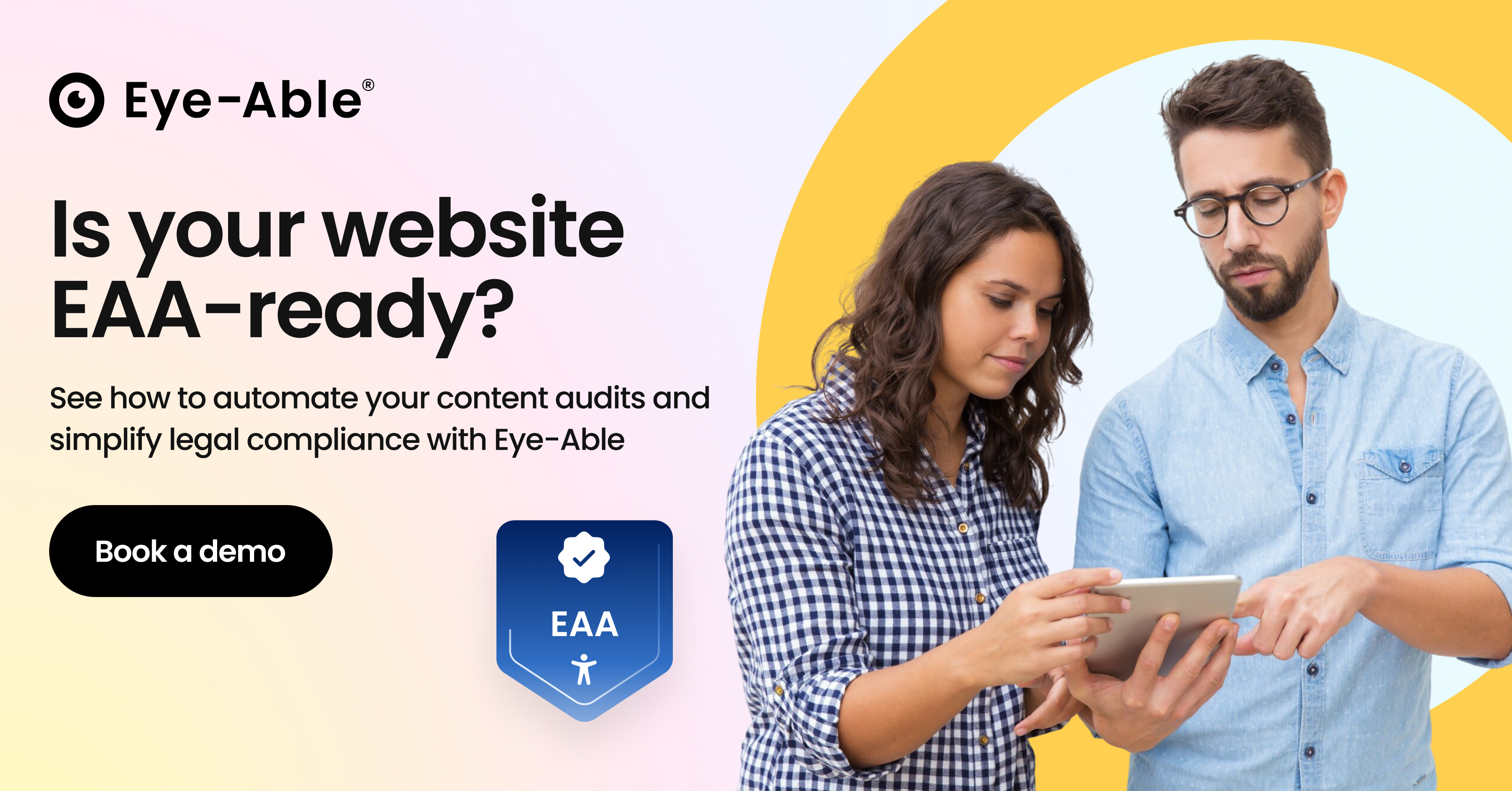
Meeting legal requirements can seem complex—but you don’t have to go it alone. Eye-Able provides a comprehensive platform to help you make your digital solutions both legally compliant and user-friendly.
Software solutions: From visual adjustment tools to automated testing tools, Eye-Able helps you identify and resolve barriers on your websites in real time.
Audits: We perform detailed audits based on WCAG 2.2 and generate the necessary reports you need for your declaration of conformity.
Documentation: Digital accessibility doesn’t end with technical implementation. For many websites and applications, an Accessibility Statement is a legal requirement.
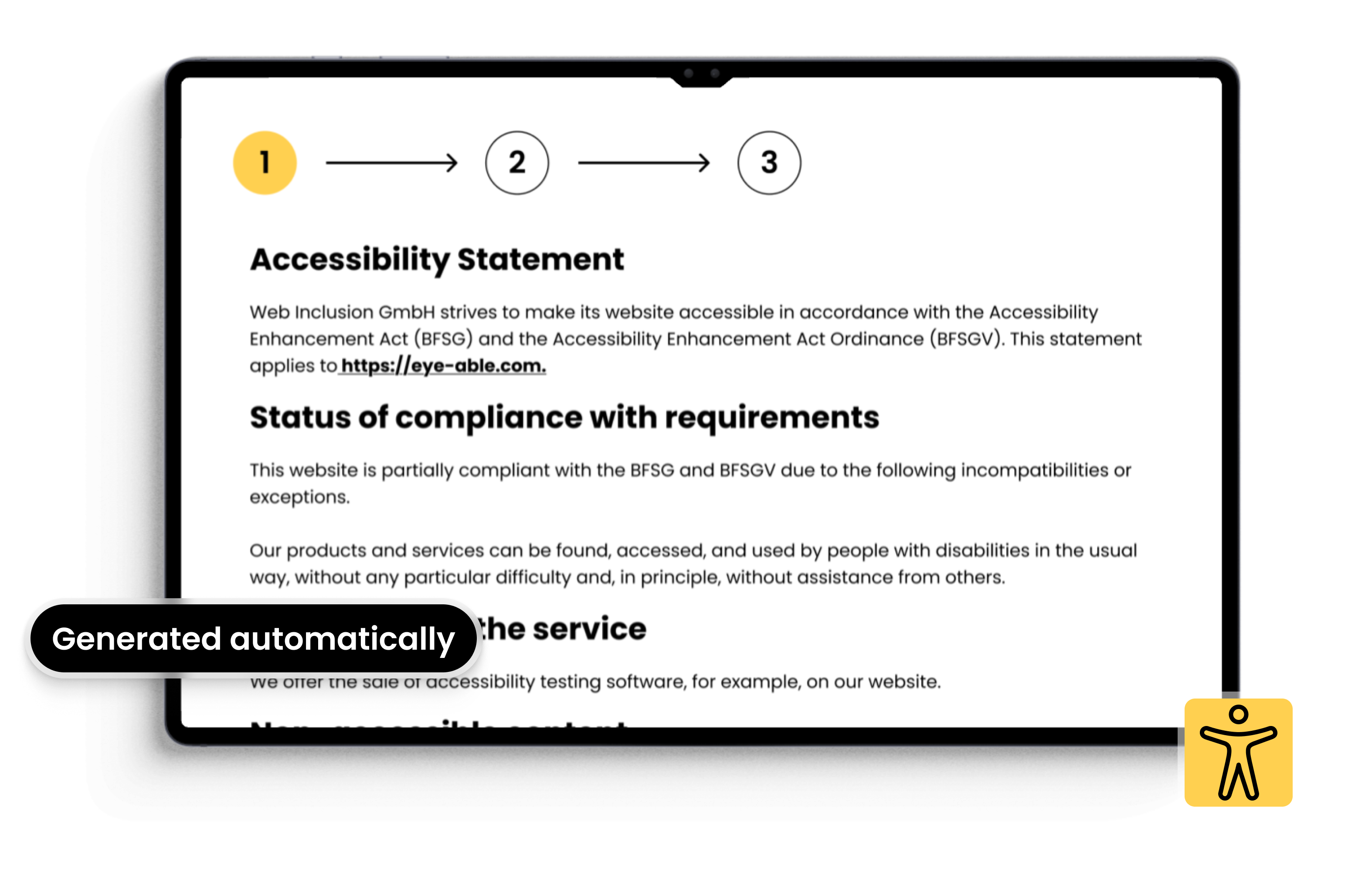 Eye-Able supports you with an Accessibility Statement Generator, which creates a structured, legally compliant declaration based on your audits—tailored to current requirements. Changes can be updatedat any time without having to manually recreate the statement.
This ensures you not only fulfil your formal obligations but also stay on top of audits, enquiries, or tenders.
Let’s check together whether your current infrastructure meets the Web Content Accessibility Guidelines (WCAG). Eye-Able helps you take your accessible websites and digital services to the next level.
Krijg een eerste overzicht van de toegankelijkheidsstatus van uw website – geheel vrijblijvend en zonder dat u voorafgaande expertise nodig hebt.
Veelgestelde vragen
In principe is de EAA gericht op digitale aanbiedingen die bestemd zijn voor consumenten. Pure B2B-websites die zich uitsluitend richten op bedrijven en geen diensten aan particulieren aanbieden, vallen over het algemeen niet onder de EAA.
De wet kan echter van toepassing zijn zodra specifieke onderdelen of functies van de website relevant zijn voor natuurlijke personen. Dit omvat carrière- en wervingspagina's, boekingssystemen of diensten die niet duidelijk beperkt zijn tot zakelijke klanten.
Ook al kunnen er geen contracten via een website worden afgesloten, toegankelijkheid kan nog steeds relevant zijn. De doorslaggevende factor is niet het contract zelf, maar of er digitale interactiemogelijkheden worden geboden die door consumenten kunnen worden gebruikt.
Contactformulieren, afspraakplanning of serviceaanvragen kunnen leiden tot specifieke toegankelijkheidsvereisten, zelfs op websites die voornamelijk op B2B gericht zijn.
Carrière- en wervingspagina's vormen een bijzonder geval. Ze zijn gericht op natuurlijke personen (individuen), niet op bedrijven, waardoor ze in de context van toegankelijkheid zeer relevant zijn. Zelfs voor bedrijven die uitsluitend in de B2B-sector actief zijn, zouden carrièrepagina's toegankelijk moeten zijn.
Als een bedrijf zowel B2B- als B2C-diensten aanbiedt, worden deze juridisch gezien afzonderlijk beschouwd. Als een B2C-aanbod bijvoorbeeld op een eigen subdomein is gehost, kan dit onder de EAA vallen, terwijl het puur B2B-hoofddomein daar niet door wordt beïnvloed.
Dit vereist echter een duidelijke technische en inhoudelijke aanpak. scheiding Als de inhoud of functies gemengd zijn, kunnen er bredere toegankelijkheidsvereisten gelden.
In de praktijk is een selectieve implementatie meestal onvoldoende. Toegankelijkheid raakt fundamentele aspecten zoals navigatie, structuur, contrasten en gebruiksvriendelijkheid, waardoor het moeilijk is om het te beperken tot individuele functies. Zodra de EAA van toepassing is, moet de website als geheel toegankelijk zijn.
Voor Ingesloten content zoals boekingssystemen, reviewwidgets of andere externe applicaties: iedereen die dergelijke content in zijn eigen website integreert, is verantwoordelijk voor de bruikbaarheid ervan. Als deze functies relevant zijn onder de EAA (Employment Access Act), moeten ze toegankelijk zijn of moet er een toegankelijk alternatief worden geboden.
Een overlay maakt een website niet vanzelf toegankelijk
Lees verhaal:no_upscale())
Digitale toegankelijkheid en SEO: waarom ook Google van deze websites houdt
Lees verhaal:no_upscale():format(png))
"Digitale toegankelijkheid is nu geen prioriteit" - en dat kost je elke dag omzet
Lees verhaal:no_upscale():format(png))
Toegankelijkheid iPhone: zo haal je alles uit de toegankelijkheidsinstellingen
Lees verhaal:no_upscale():format(png))
Mobiele toegankelijkheid: ben jij er klaar voor?
Lees verhaal
AI accessibility: Hoe organisaties inclusieve digitale ervaringen maken
Lees verhaal:no_upscale():format(png))
Eye-Able als alternatief: wat organisaties écht nodig hebben
Lees verhaal:no_upscale())
Hoe kom ik aan een toegankelijkheidsverklaring voor de EAA?
Lees verhaal:no_upscale())
Wat is Alt Tekst voor obstakelvrij lezen van beelden?
Lees verhaal:no_upscale())
Hoe AI een handje helpt bij de Wet Digitale Toegankelijkheid
Lees verhaal:no_upscale())
Veelgemaakte fouten Wet Digitale Toegankelijkheid (EAA)
Lees verhaal:no_upscale())
De Wet Digitale Toegankelijkheid (EAA) voor het MKB: Zo krijg je je medewerkers mee!
Lees verhaal:no_upscale():format(png))
:no_upscale():format(png))