
 The EAA B2B Check
The European Accessibility Act (EAA) aims to harmonise the EU internal market for digital products and digital services.
While the legislation primarily focuses on consumer protection (B2C), it impacts the B2B sector through several "backdoors" simultaneously.
In this article, you’ll learn:
why the EAA is also relevant for B2B companies
in which specific B2B scenarios action is required
how to prepare strategically and in a legally compliant way
 When you must take action in the B2B sector
Product liability and placing on the market
Do you manufacture hardware (e.g. computers or routers) that is, by its nature, suitable for consumers?
If so, these digital products must be accessible – regardless of whether you sell them to a distributor or another business.
Example:
Even if you sell 5,000 of these notebooks to a corporation in a pure B2B transaction, they must be fully accessible. You cannot claim exemption just because no end-consumer is named in the salescontract. As soon as the product is placed on the market, it must meet the legal standards.
Accessibility is a mandatory product feature – just like electrical safety.
Digital services in the supply chain
If you provide a software solution used by a B2C company to fulfil its own obligations (e.g. a checkout system or a customer portal), your client will contractually demand compliance with accessibility standards from you.
Example:
A fintech startup offers an innovative checkout system for online shops. The online shop (B2C) is legally required to make the entire purchasing process accessible. Since the checkout is the core ofthis process, the shop operator will only use a system that meets WCAG 2.1 and, looking ahead, WCAG 2.2. Without compliance, the fintech startup loses its entire B2C customer base.
 Public procurement (B2G)
While public bodies are governed by specific national accessibility regulations (such as the UK’s PSBAR or Germany’s BITV 2.0), they are increasingly awarding contracts only to providers whose products meet these requirements.
For B2B companies, this means that even if they do not fall directly under the EAA, accessibility is becoming a decisive award criterion in tenders.
Example:
A B2B company bids for a government agency tender for new HR management software. Since public authorities are mandated to ensure accessibility, the compliance of the user interface is a strict exclusion criterion.
Technical standards: WCAG and assistive technologies
To meet the requirements for digital accessibility, the Web Content Accessibility Guidelines (WCAG) are the central benchmark.
Currently, WCAG 2.1 Level AA is the legally authoritative standard referenced by the EAA.
Looking ahead, however, WCAG 2.2 is considered the state-of-the-art standard. Companies that already align their digital offerings with WCAG 2.2 are better prepared for future requirements and reduce the risk of costly retrofitting.
Why WCAG matters to you
Accessibility means more than just contrast ratios. It is about ensuring your interactive websites are compatible with assistive technologies such as screen readers, Braille displays, or voice control systems. This is the only way to ensure that people with disabilities can use your digital services to their full extent.
How Eye-Able supports your implementation
Meeting legal requirements can seem complex—but you don’t have to go it alone. Eye-Able provides a comprehensive platform to help you make your digital solutions both legally compliant and user-friendly.
Software solutions: From visual adjustment tools to automated testing tools, Eye-Able helps you identify and resolve barriers on your websites in real time.
Audits: We perform detailed audits based on WCAG 2.2 and generate the necessary reports you need for your declaration of conformity.
Documentation: Digital accessibility doesn’t end with technical implementation. For many websites and applications, an Accessibility Statement is a legal requirement.
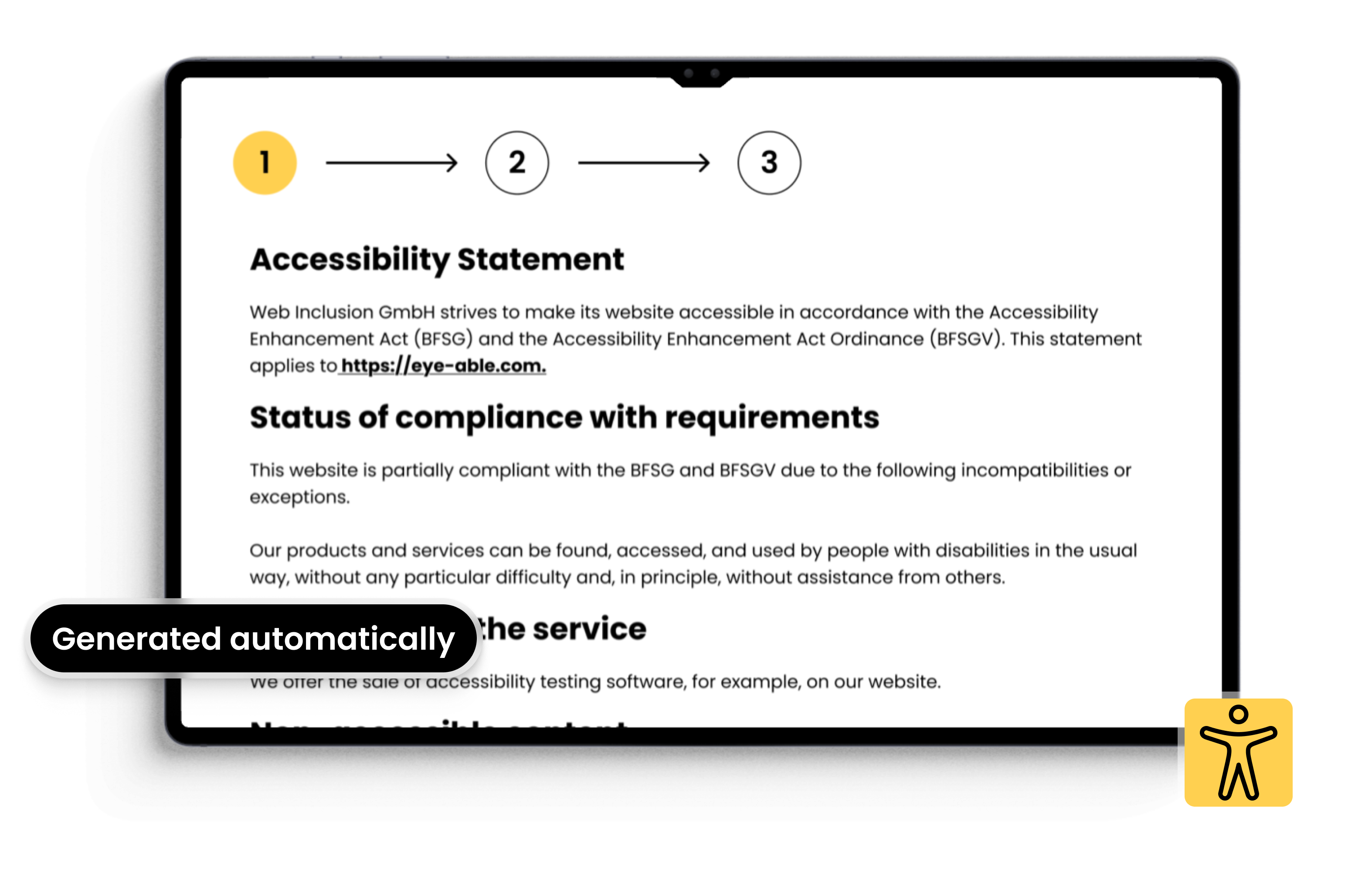 Eye-Able supports you with an Accessibility Statement Generator, which creates a structured, legally compliant declaration based on your audits—tailored to current requirements. Changes can be updatedat any time without having to manually recreate the statement.
This ensures you not only fulfil your formal obligations but also stay on top of audits, enquiries, or tenders.
Want to ensure your B2B platform is future-proof?
Let’s check together whether your current infrastructure meets the Web Content Accessibility Guidelines (WCAG). Eye-Able helps you take your accessible websites and digital services to the next level.
Get an initial overview of your website’s accessibility status – with no obligation and no prior expertise required.
Frequently Asked Questions
FAQ on the EAA in a B2B context
In principle, the EAA targets digital offerings aimed at consumers. Pure B2B websites that exclusively address businesses and offer no services to private individuals generally do not fall under the EAA.
However, the Act can apply as soon as specific areas or functions of the website are relevant to natural persons. This includes career and recruitment pages, booking systems, or service offerings that are not clearly restricted to business clients.
Even if no contracts can be concluded via a website, accessibility may still be relevant. The deciding factor is not the contract itself, but whether digital interactions are offered that can be used by consumers.
Contact forms, appointment scheduling, or service enquiries can lead to specific accessibility requirements—even on predominantly B2B-oriented websites.
Career and recruitment pages are a special case. They are directed at natural persons (individuals), not businesses, making them highly relevant in the context of accessibility. Even for companies operatingexclusively in the B2B sector, career sections should be designed to be accessible.
If a company provides both B2B and B2C offerings, these are viewed separately from a legal perspective. If a B2C offering is located on its own subdomain, for example, it may fall under the EAA while the purelyB2B main area is not affected.
However, this requires a clear technical and content-based separation. If content or functions are mixed, broader accessibility requirements may apply.
In practice, a selective implementation is usually insufficient. Accessibility affects fundamental aspects like navigation, structure, contrasts, and usability, making it difficult to limit to individual functions. Oncethe EAA is applicable, the website must be accessible as a whole.
For embedded content such as booking tools, review widgets, or other external applications: anyone integrating such content into their own website bears responsibility for its usability. If these functions are relevant under the EAA, they must either be accessible or an accessible alternative must be provided.
Filter
:no_upscale():format(png))
:no_upscale():format(png))