
 The EAA B2B Check
The European Accessibility Act (EAA) aims to harmonise the EU internal market for digital products and digital services.
While the legislation primarily focuses on consumer protection (B2C), it impacts the B2B sector through several "backdoors" simultaneously.
In this article, you’ll learn:
why the EAA is also relevant for B2B companies
in which specific B2B scenarios action is required
how to prepare strategically and in a legally compliant way
 When you must take action in the B2B sector
Product liability and placing on the market
Do you manufacture hardware (e.g. computers or routers) that is, by its nature, suitable for consumers?
If so, these digital products must be accessible – regardless of whether you sell them to a distributor or another business.
Example:
Even if you sell 5,000 of these notebooks to a corporation in a pure B2B transaction, they must be fully accessible. You cannot claim exemption just because no end-consumer is named in the salescontract. As soon as the product is placed on the market, it must meet the legal standards.
Accessibility is a mandatory product feature – just like electrical safety.
Digital services in the supply chain
If you provide a software solution used by a B2C company to fulfil its own obligations (e.g. a checkout system or a customer portal), your client will contractually demand compliance with accessibility standards from you.
Example:
A fintech startup offers an innovative checkout system for online shops. The online shop (B2C) is legally required to make the entire purchasing process accessible. Since the checkout is the core ofthis process, the shop operator will only use a system that meets WCAG 2.1 and, looking ahead, WCAG 2.2. Without compliance, the fintech startup loses its entire B2C customer base.
 Public procurement (B2G)
While public bodies are governed by specific national accessibility regulations (such as the UK’s PSBAR or Germany’s BITV 2.0), they are increasingly awarding contracts only to providers whose products meet these requirements.
For B2B companies, this means that even if they do not fall directly under the EAA, accessibility is becoming a decisive award criterion in tenders.
Example:
A B2B company bids for a government agency tender for new HR management software. Since public authorities are mandated to ensure accessibility, the compliance of the user interface is a strict exclusion criterion.
Technical standards: WCAG and assistive technologies
To meet the requirements for digital accessibility, the Web Content Accessibility Guidelines (WCAG) are the central benchmark.
Currently, WCAG 2.1 Level AA is the legally authoritative standard referenced by the EAA.
Looking ahead, however, WCAG 2.2 is considered the state-of-the-art standard. Companies that already align their digital offerings with WCAG 2.2 are better prepared for future requirements and reduce the risk of costly retrofitting.
Why WCAG matters to you
Accessibility means more than just contrast ratios. It is about ensuring your interactive websites are compatible with assistive technologies such as screen readers, Braille displays, or voice control systems. This is the only way to ensure that people with disabilities can use your digital services to their full extent.
How Eye-Able supports your implementation
Meeting legal requirements can seem complex—but you don’t have to go it alone. Eye-Able provides a comprehensive platform to help you make your digital solutions both legally compliant and user-friendly.
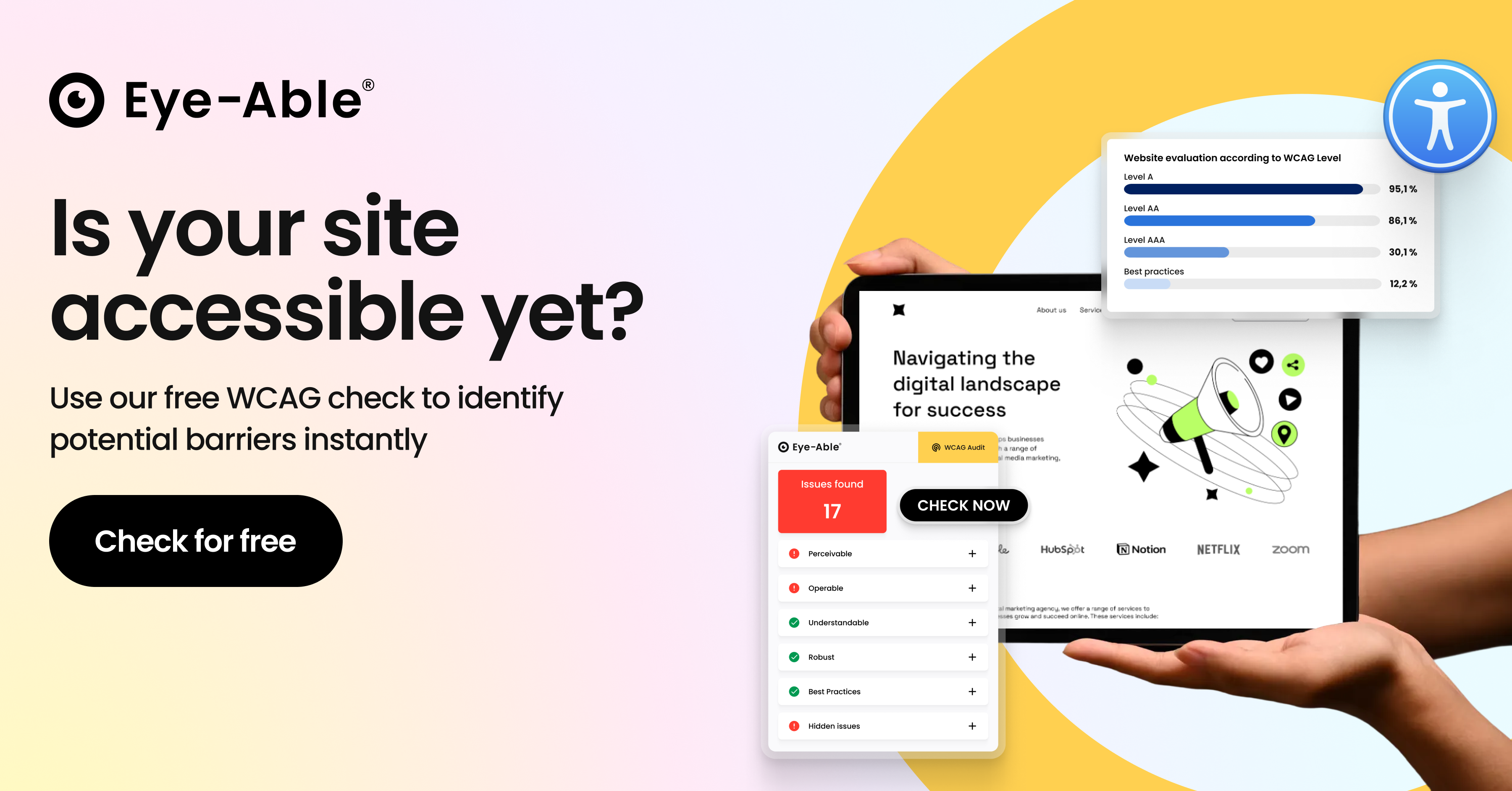
Software solutions: From visual adjustment tools to automated testing tools, Eye-Able helps you identify and resolve barriers on your websites in real time.
Audits: We perform detailed audits based on WCAG 2.2 and generate the necessary reports you need for your declaration of conformity.
Documentation: Digital accessibility doesn’t end with technical implementation. For many websites and applications, an Accessibility Statement is a legal requirement.
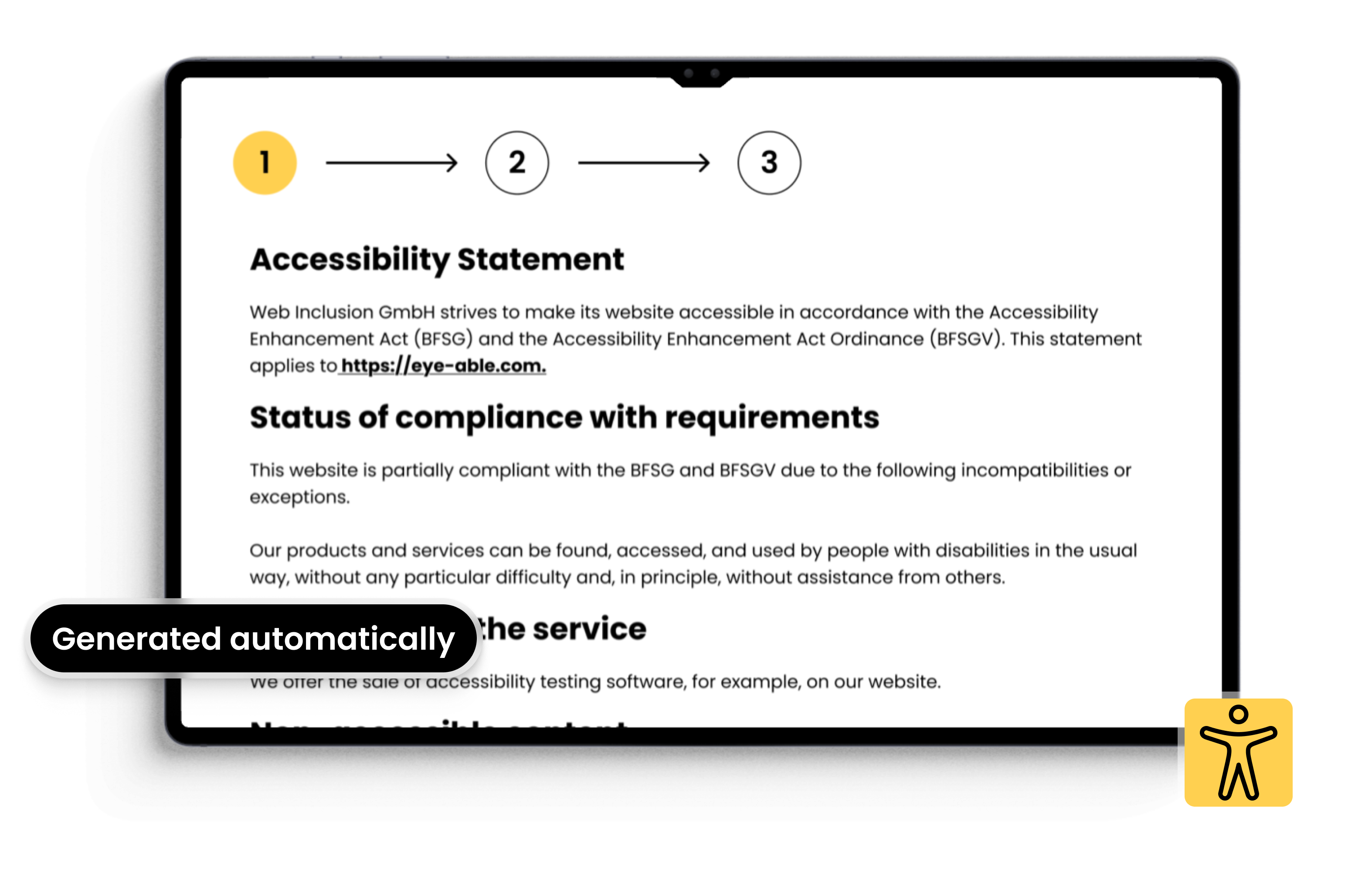 Eye-Able supports you with an Accessibility Statement Generator, which creates a structured, legally compliant declaration based on your audits—tailored to current requirements. Changes can be updatedat any time without having to manually recreate the statement.
This ensures you not only fulfil your formal obligations but also stay on top of audits, enquiries, or tenders.
Want to ensure your B2B platform is future-proof?
Let’s check together whether your current infrastructure meets the Web Content Accessibility Guidelines (WCAG). Eye-Able helps you take your accessible websites and digital services to the next level.
Få en första översikt över din webbplats tillgänglighetsstatus – utan förpliktelser och utan krav på förkunskaper.
Vanliga frågor
Vanliga frågor om EAA i ett B2B-sammanhang
I princip riktar sig EAA till digitala erbjudanden riktade till konsumenter. Rena B2B-webbplatser som uteslutande riktar sig till företag och inte erbjuder några tjänster till privatpersoner omfattas i allmänhet inte av EAA.
Lagen kan dock tillämpas så snart specifika områden eller funktioner på webbplatsen är relevanta för fysiska personer. Detta inkluderar karriär- och rekryteringssidor, bokningssystem eller tjänsteerbjudanden som inte tydligt är begränsade till företagskunder.
Även om inga avtal kan ingås via en webbplats kan tillgänglighet fortfarande vara relevant. Den avgörande faktorn är inte själva avtalet, utan huruvida digitala interaktioner erbjuds som kan användas av konsumenter.
Kontaktformulär, tidsbokning eller serviceförfrågningar kan leda till specifika tillgänglighetskrav – även på webbplatser som huvudsakligen är B2B-inriktade.
Karriär- och rekryteringssidor är ett specialfall. De riktar sig till fysiska personer (privatpersoner), inte företag, vilket gör dem mycket relevanta i tillgänglighetssammanhang. Även för företag som uteslutande verkar inom B2B-sektorn bör karriärsektioner utformas för att vara tillgängliga.
Om ett företag erbjuder både B2B- och B2C-erbjudanden ses dessa separat ur ett juridiskt perspektiv. Om ett B2C-erbjudande till exempel finns på en egen underdomän kan det falla under EAA medan det renodlade B2B-huvudområdet inte påverkas.
Detta kräver dock en tydlig teknisk och innehållsbaserad separation Om innehåll eller funktioner är blandade kan bredare tillgänglighetskrav gälla.
I praktiken är en selektiv implementering oftast otillräcklig. Tillgänglighet påverkar grundläggande aspekter som navigering, struktur, kontraster och användbarhet, vilket gör det svårt att begränsa sig till enskilda funktioner. När EAA är tillämpligt måste webbplatsen vara tillgänglig som helhet.
För Inbäddat innehåll såsom bokningsverktyg, recensionswidgetar eller andra externa applikationer: alla som integrerar sådant innehåll på sin egen webbplats bär ansvar för dess användbarhet. Om dessa funktioner är relevanta enligt EAA måste de antingen vara tillgängliga eller så måste ett tillgängligt alternativ tillhandahållas.
Filter
:no_upscale():format(png))
:no_upscale():format(png))