:no_upscale())
Pourquoi 4 géants de la grande distribution sont poursuivis en justice
Lire l'histoire
 The EAA B2B Check
 The European Accessibility Act (EAA) aims to harmonise the EU internal market for digital products and digital services.
While the legislation primarily focuses on consumer protection (B2C), it impacts the B2B sector through several "backdoors" simultaneously.
In this article, you’ll learn:
why the EAA is also relevant for B2B companies
in which specific B2B scenarios action is required
how to prepare strategically and in a legally compliant way
 When you must take action in the B2B sector
Do you manufacture hardware (e.g. computers or routers) that is, by its nature, suitable for consumers?
If so, these digital products must be accessible – regardless of whether you sell them to a distributor or another business.
Example:
Even if you sell 5,000 of these notebooks to a corporation in a pure B2B transaction, they must be fully accessible. You cannot claim exemption just because no end-consumer is named in the salescontract. As soon as the product is placed on the market, it must meet the legal standards.
Accessibility is a mandatory product feature – just like electrical safety.
If you provide a software solution used by a B2C company to fulfil its own obligations (e.g. a checkout system or a customer portal), your client will contractually demand compliance with accessibility standards from you.
Example:
A fintech startup offers an innovative checkout system for online shops. The online shop (B2C) is legally required to make the entire purchasing process accessible. Since the checkout is the core ofthis process, the shop operator will only use a system that meets WCAG 2.1 and, looking ahead, WCAG 2.2. Without compliance, the fintech startup loses its entire B2C customer base.
 Public procurement (B2G)
While public bodies are governed by specific national accessibility regulations (such as the UK’s PSBAR or Germany’s BITV 2.0), they are increasingly awarding contracts only to providers whose products meet these requirements.
For B2B companies, this means that even if they do not fall directly under the EAA, accessibility is becoming a decisive award criterion in tenders.
Example:
A B2B company bids for a government agency tender for new HR management software. Since public authorities are mandated to ensure accessibility, the compliance of the user interface is a strict exclusion criterion.
To meet the requirements for digital accessibility, the Web Content Accessibility Guidelines (WCAG) are the central benchmark.
Currently, WCAG 2.1 Level AA is the legally authoritative standard referenced by the EAA.
Looking ahead, however, WCAG 2.2 is considered the state-of-the-art standard. Companies that already align their digital offerings with WCAG 2.2 are better prepared for future requirements and reduce the risk of costly retrofitting.
Accessibility means more than just contrast ratios. It is about ensuring your interactive websites are compatible with assistive technologies such as screen readers, Braille displays, or voice control systems. This is the only way to ensure that people with disabilities can use your digital services to their full extent.
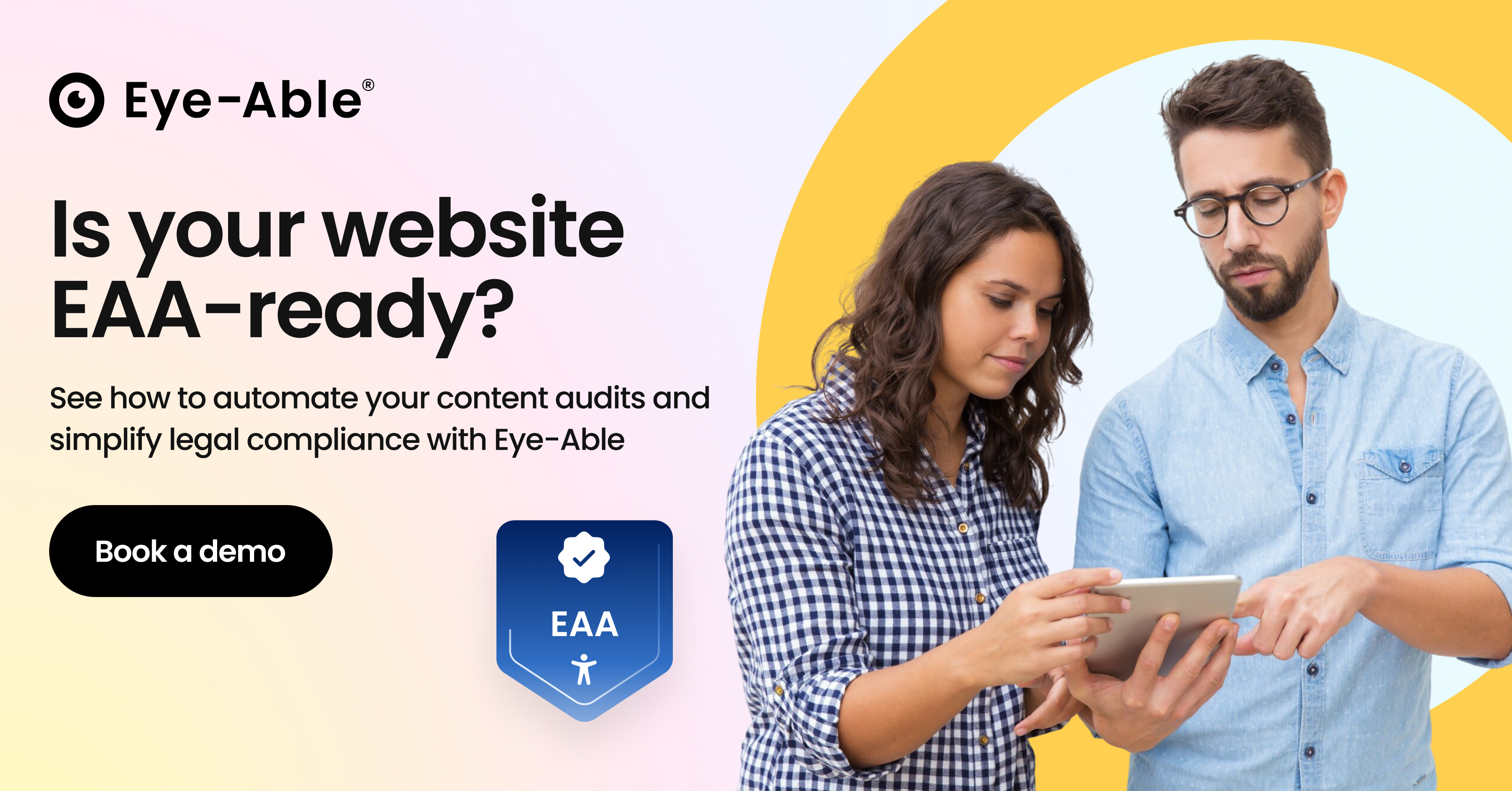
Meeting legal requirements can seem complex—but you don’t have to go it alone. Eye-Able provides a comprehensive platform to help you make your digital solutions both legally compliant and user-friendly.
Software solutions: From visual adjustment tools to automated testing tools, Eye-Able helps you identify and resolve barriers on your websites in real time.
Audits: We perform detailed audits based on WCAG 2.2 and generate the necessary reports you need for your declaration of conformity.
Documentation: Digital accessibility doesn’t end with technical implementation. For many websites and applications, an Accessibility Statement is a legal requirement.
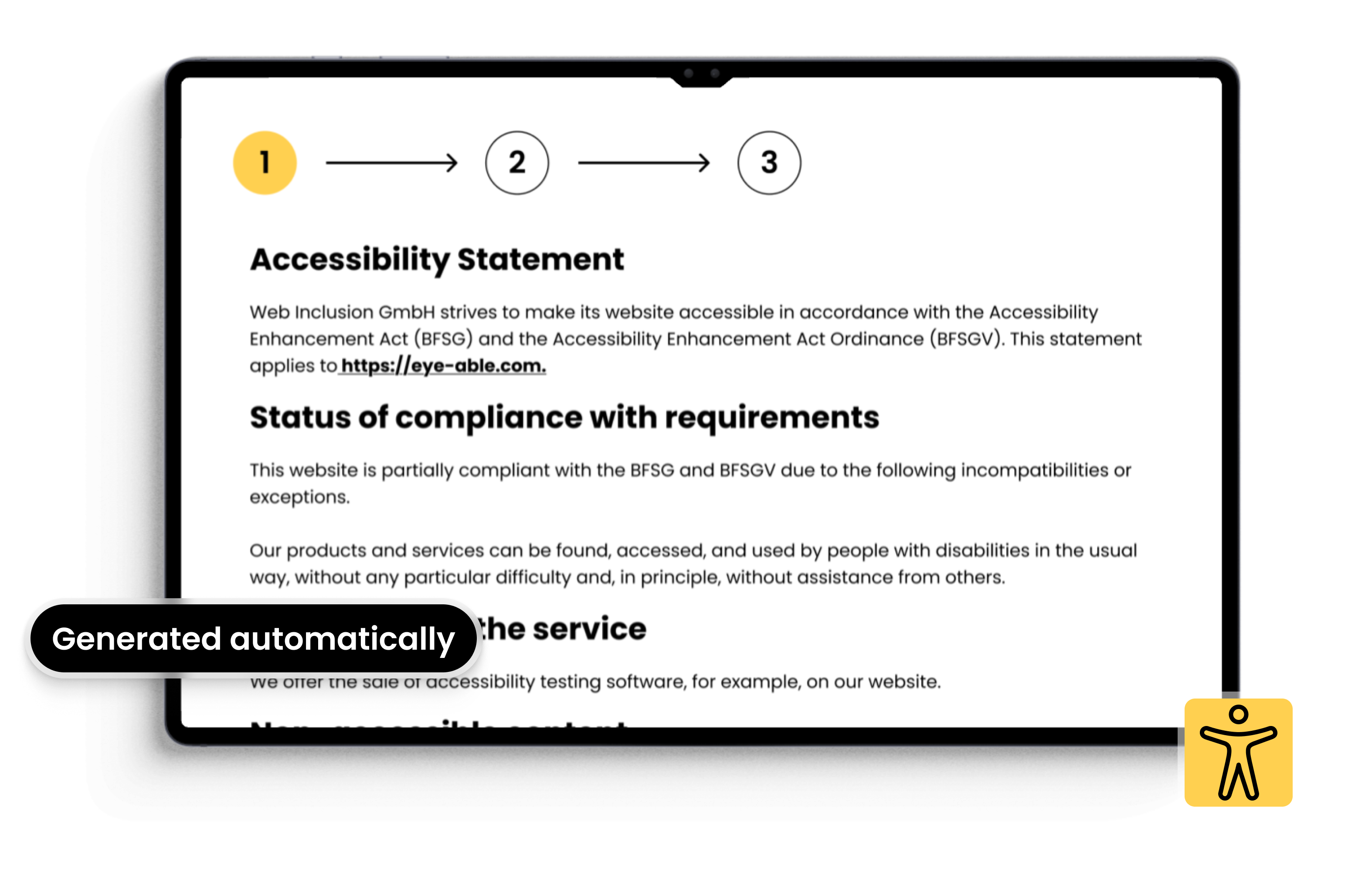 Eye-Able supports you with an Accessibility Statement Generator, which creates a structured, legally compliant declaration based on your audits—tailored to current requirements. Changes can be updatedat any time without having to manually recreate the statement.
This ensures you not only fulfil your formal obligations but also stay on top of audits, enquiries, or tenders.
Let’s check together whether your current infrastructure meets the Web Content Accessibility Guidelines (WCAG). Eye-Able helps you take your accessible websites and digital services to the next level.
Obtenez un aperçu initial de l'accessibilité de votre site web – sans engagement et sans expertise préalable requise.
Foire aux questions
En principe, la loi sur l'accès à Internet (EAA) vise les offres numériques destinées aux consommateurs. Les sites web B2B qui s'adressent exclusivement aux entreprises et ne proposent aucun service aux particuliers ne sont généralement pas concernés par l'EAA.
Cependant, la loi peut s'appliquer dès lors que certaines parties ou fonctionnalités du site web concernent des personnes physiques. Cela inclut les pages carrières et recrutement, les systèmes de réservation ou les offres de services qui ne sont pas clairement réservées à une clientèle professionnelle.
Même si aucun contrat ne peut être conclu via un site web, l'accessibilité peut néanmoins être pertinente. Le facteur déterminant n'est pas le contrat lui-même, mais la mise à disposition d'interactions numériques utilisables par les consommateurs.
Les formulaires de contact, la prise de rendez-vous ou les demandes de renseignements sur les services peuvent engendrer des exigences d'accessibilité spécifiques, même sur des sites Web principalement destinés aux entreprises (B2B).
Les pages carrières et recrutement constituent un cas particulier. Destinées aux personnes physiques et non aux entreprises, elles sont donc particulièrement concernées par les questions d'accessibilité. Même pour les entreprises opérant exclusivement dans le secteur B2B, les sections carrières doivent être conçues pour être accessibles.
Si une entreprise propose des services B2B et B2C, ces derniers sont considérés séparément d'un point de vue juridique. Par exemple, si un service B2C est hébergé sur un sous-domaine dédié, il peut être soumis à la loi sur l'accès équitable aux services (EAA), tandis que le domaine principal, exclusivement B2B, ne l'est pas.
Toutefois, cela nécessite une approche technique et de contenu claire. séparation Si le contenu ou les fonctions sont mixtes, des exigences d'accessibilité plus larges peuvent s'appliquer.
En pratique, une mise en œuvre sélective est généralement insuffisante. L'accessibilité touche des aspects fondamentaux tels que la navigation, la structure, les contrastes et l'ergonomie, ce qui rend difficile de se limiter à des fonctions individuelles. Dès lors que la loi sur l'accessibilité pour tous (EAA) est applicable, le site web doit être accessible dans son ensemble.
Pour Concernant les contenus intégrés tels que les outils de réservation, les widgets d'avis ou autres applications externes : toute personne intégrant ces contenus à son site web est responsable de leur accessibilité. Si ces fonctionnalités relèvent de la loi sur l'accessibilité pour les personnes handicapées (EAA), elles doivent être accessibles ou une alternative accessible doit être proposée.
Pourquoi 4 géants de la grande distribution sont poursuivis en justice
Lire l'histoire:no_upscale():format(png))
:no_upscale():format(png))