:no_upscale())
Talking to everyone about everything: a guide to inclusive language
Read story
 What has changed since June 2025?
Since June 2025, the EAA has moved from something businesses were preparing for to something they actually have to deal with.
Authorities are starting investigations, accessibility is showing up more often in digital projects and companies are under more pressure to fix barriers in websites, apps and online services.
But progress is still uneven. Some countries are moving faster than others, and many everyday problems are still there, especially in forms, logins, payments and booking processes.
So yes, more is happening. But accessible digital services are still far from being the norm.
The honest answer is: many are still not.
According to the Digital Trust Index 2026, 91.45 per cent of the European homepages tested had accessibility issues. The study examined 326,250 homepages across 18 countries using automated checks.
The most common problems were familiar ones:
poor colour contrast,
missing alternative text, and
unclear links or buttons.
This does not mean that more than 90 per cent of European websites break the law. The study only examined homepages and could only detect certain technical issues automatically. It did not test whether someone could open an account, place an order or complete a payment.
Still, the result shows how widespread even basic barriers remain. And the biggest problems often appear once someone tries to complete a task.
The EAA provides a common framework, but each country applies and enforces it through its own national law. Since 28 June 2025, accessibility requirements have covered selected private sector products and services, including online retail, banking, electronic communications, e-books and parts of passenger transport.
The exact rules, exemptions and responsible authorities vary between countries. Enforcement does too.
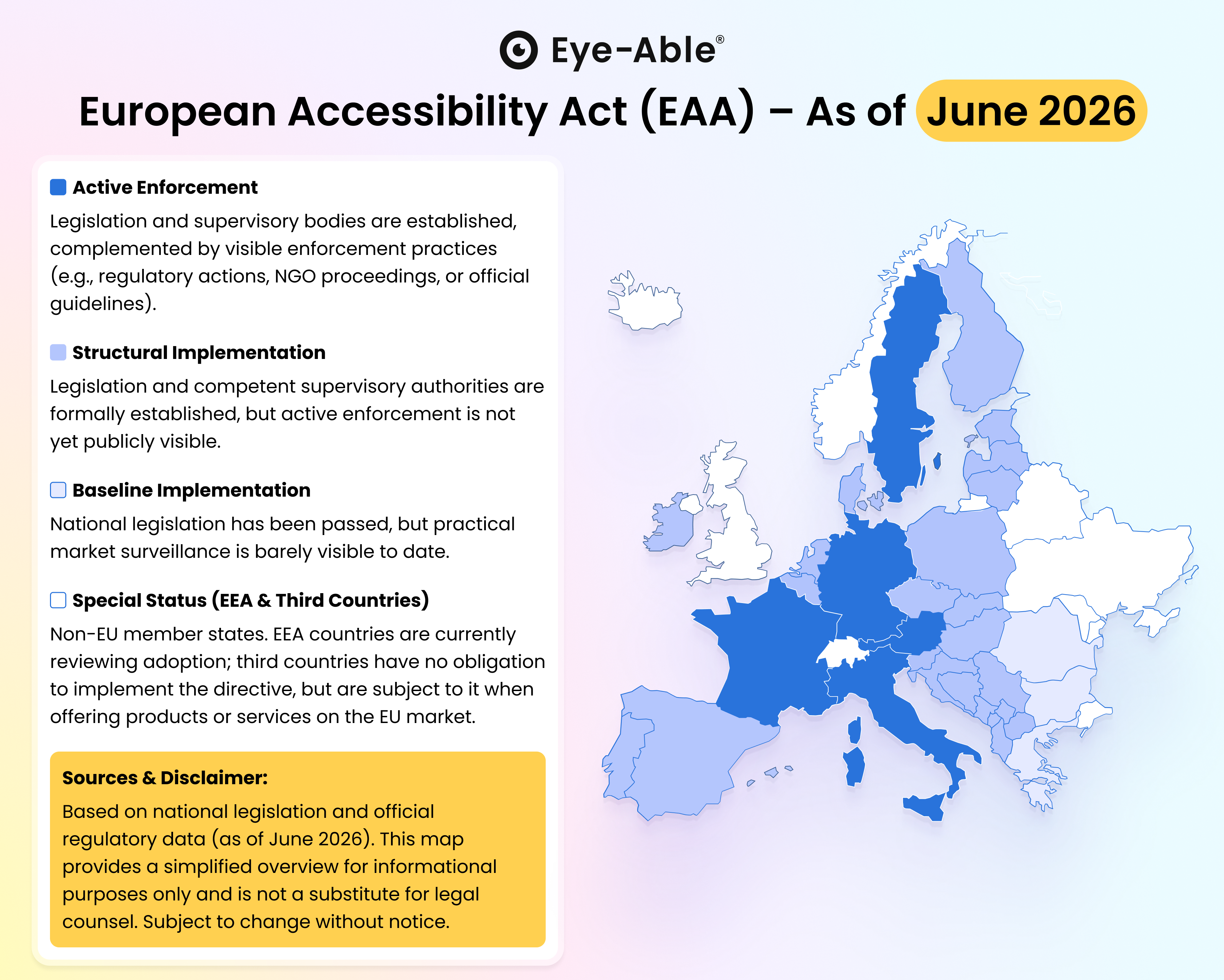
The map below shows where regulatory activity is already visible and where practical enforcement remains limited.
 Accessibility is about more than ticking boxes
 For businesses, the first question is often whether a product or service falls within the law. For people using it, the question is much simpler: does it work?
Can a blind person choose a product and pay independently? Can someone with a motor disability complete a booking using only a keyboard? Does the content still make sense when enlarged? Can a screen reader understand the confirmation message?
This is where accessibility becomes real.
Publishing accessibility information does not make an online shop accessible. Automated checks are useful, but they cannot show whether someone can create an account, buy a ticket or complete a payment. What matters is the whole journey.
The gaps are easiest to see in services that people use every day. Whether the EAA applies depends on the specific product or service, not simply on the industry.
Online shops are one of the clearest areas covered by the EAA. Yet barriers can appear at almost every stage of the buying process:
Products cannot be selected using a keyboard.
Filters are not announced clearly by screen readers.
Error messages rely on colour or disappear too quickly.
Shopping basket controls do not have clear labels.
Required fields are not announced correctly during payment.
The biggest problems are often found beyond the homepage. Product filters, customer accounts, delivery options and checkout processes reveal whether a shop is genuinely usable.
Accessible digital banking is essential for financial independence. People should be able to transfer money, check their balance and download bank statements without relying on someone else.
Many banks have improved their public information pages. The problems often begin once customers log in.
Forms may not be labelled clearly. Visual financial summaries may lack accessible alternatives. Bank statements may be provided as inaccessible PDF files.
Authentication can create another barrier. If an approval request in a banking app does not work with a screen reader, or a time-limited code expires too quickly, an independent transaction may become impossible.
Security and accessibility should not be treated as opposing goals. A secure process is not effective if some customers cannot use it.
Poland offers a concrete example of why small design decisions matter.
A partially sighted bank customer could not confirm BLIK payments within the 20 seconds allowed by their banking app. Listening to the screen reader and entering the PIN simply took too long.
After the Polish Financial Ombudsman intervened, the bank extended the confirmation time to 25 seconds. This was not a formal EAA enforcement case, but the lesson is highly relevant: accessibility is often decided in the details. Sometimes, just a few extra seconds determine whether someone can complete a payment independently.
In transport, digital and physical accessibility are closely linked. If someone cannot find a route or buy a ticket, they may not be able to make the journey at all.
Common problems include interactive maps that do not work with screen readers, poor contrast in live travel information and time limits that expire before a booking has been completed.
The EAA covers selected websites, apps and electronic ticketing services in passenger transport. The exact scope depends on the type of service and the way the rules have been implemented nationally.
Accessibility also matters when plans change. Information about broken lifts, platform changes or cancelled services must be easy to find and accessible with assistive technology.
Although Norway is not an EU member state, its approach offers a useful example for EU countries.
The Norwegian Authority for Universal Design of ICT names the apps of Ruter, Avinor and SAS as examples covered by Norway’s accessibility requirements. It also recommends testing apps with screen readers on both iOS and Android to make sure that navigation, menus and content work with assistive technology.
The lesson is simple: accessible travel does not begin at the station or airport. It begins when someone opens an app to plan a journey, buy a ticket or manage their trip.
Health services do not automatically fall under the EAA simply because they operate in healthcare. An online pharmacy may, however, be covered as an e-commerce service. Other digital health services may also fall within national rules depending on what they offer.
The consequences of inaccessible services can be particularly serious in healthcare. People need to be able to book appointments, order medication and access important information about their treatment.
A homepage score says little about whether someone can complete an appointment booking, upload a prescription or order medication independently.
Sweden shows how this can work in practice. In March 2026, the Swedish Post and Telecom Authority included five online pharmacies in its planned accessibility investigations: Apotea, Apotek Hjärtat, Kronans Apotek, Apoteket and Apohem.
They are being assessed under the rules for e-commerce services, alongside online businesses from other sectors. The authority is checking whether their websites are perceivable, operable, understandable and robust, as well as whether information about the service is provided accessibly.
In sport and culture, the legal position also depends on the service being offered. When tickets are sold online, the booking process will often count as e-commerce and may therefore fall within national accessibility rules.
Digital seating plans remain a common obstacle. Blind people may not be able to understand the layout, while keyboard users may struggle to reach or select individual seats.
There is often a second barrier when accessible seating is involved. Standard tickets can usually be bought online within minutes, while wheelchair spaces or companion seats still have to be requested by phone or email.
Digital participation begins long before someone arrives at a stadium, theatre or concert venue. It starts with finding information and continues through ticket selection, payment and confirmation.
The examples from banking, transport and online pharmacies show that accessibility is increasingly being examined in practice.
Authorities can respond to complaints, launch investigations or carry out checks across an entire sector. Depending on national law, they may require businesses to correct barriers, provide documentation, restrict a service or pay a fine.
Checks are not limited to the website itself. Authorities may also examine whether accessibility information has been published and whether a business has properly documented its decisions.
For businesses, this marks a clear change. Digital accessibility is no longer just a voluntary improvement. It is becoming part of everyday regulatory oversight.
The first step is to understand which products and services fall within scope and which digital touchpoints belong to them. Looking at the homepage alone is not enough.
An online shop should be tested from product search to confirmation. A bank should include the customer area and authentication process. A ticket provider should test seat selection and payment.
Automated testing is a useful starting point. It can identify many technical issues quickly. But it should always be combined with manual testing.
Testing with people with disabilities adds another important layer. It shows whether a service works in real situations, not just in theory.
Clear ownership matters too. Accessibility should not depend on one person fixing problems after launch. It needs to be built into content, design, development and quality assurance from the beginning.
And the work does not end after one update. New content, software changes and third-party tools can introduce new barriers at any time.
Digital accessibility is not a one-off project. It is an ongoing part of running a digital service.
The first year of the EAA has made digital accessibility more visible across Europe. More businesses are taking action and national enforcement is becoming more concrete.
But the available data shows that there is still a long way to go. Many websites already contain basic barriers on their homepages. The problems can become even greater in forms, customer accounts, authentication and payment processes.
The success of the EAA will not be measured by reports or published accessibility information alone.
What matters is whether people can order a product, buy a ticket or manage their money without having to ask someone else for help.
One year on, the legal framework is in place. Now accessibility needs to work in everyday digital life.
Find out if your website works for everyone—test it for free with Eye-Able!
Talking to everyone about everything: a guide to inclusive language
Read story:no_upscale())
What does an inaccessible website really cost?
Read story:no_upscale())
Your WordPress site is never really finished: Why continuous maintenance matters
Read story:no_upscale())
A New Leadership Team for Eye-Able: Oliver Berchtold Appointed CEO
Read story:no_upscale())
HubSpot drops orange: how accessibility reshaped the CRM's design
Read story:no_upscale())
AC Monza chooses Eye-Able for digital accessibility
Read story:no_upscale())
How to make your website EAA-compliant in 8 steps
Read story:no_upscale())
Looking back at the 2026 World Cup: How accessible was the tournament really?
Read story:no_upscale())
Accessibility warnings in Austria? What European businesses need to know
Read story:no_upscale())
New: Eye-Able brings digital accessibility directly into the development environment
Read story:no_upscale())
Groundbreaking new AI-powered tests come to Eye-Able Audit
Read story:no_upscale())
One year of the EAA: Where businesses still fall short
Read story:no_upscale():format(png))
:no_upscale():format(png))