:no_upscale():format(png))
How inclusive are the Paralympics?
Read story
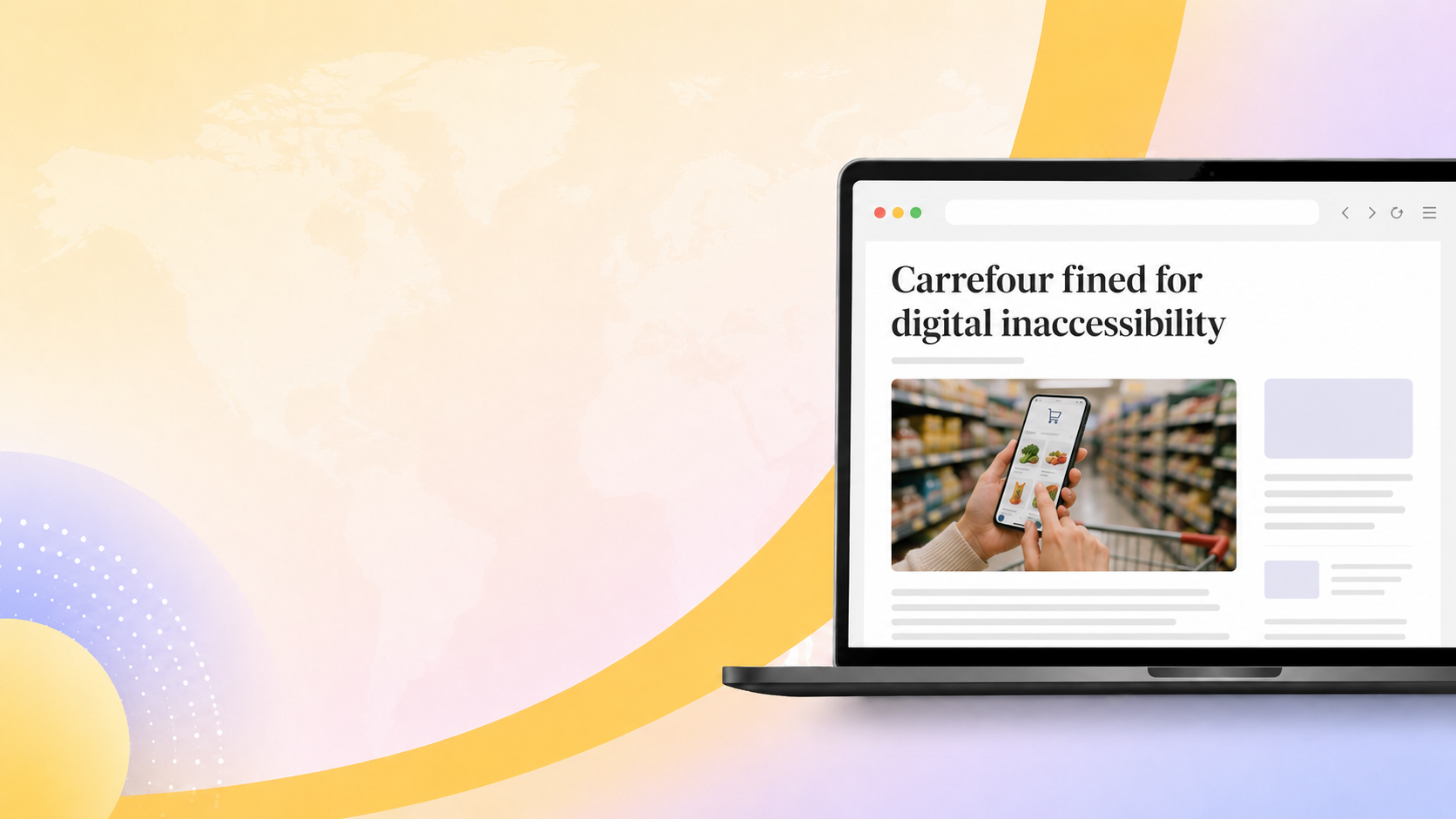 Carrefour case: What it really teaches us about accessibility
On June 4, 2026, the Caen Judicial Court issued a landmark ruling: it found Carrefour liable for the inaccessibility of its online grocery service.
But stopping at the company’s mistake would be reductive. The real point is another: this ruling shows that the European Accessibility Act is now more tangible than ever—not just as a regulatory obligation, but as a response to a real need that directly impacts people, rights, and reputation.
It all began in 2025, when the French associations ApiDV and Droit Pluriel reported widespread issues in online grocery services across the retail sector.
In Carrefour’s case, tests carried out by blind and visually impaired users highlighted concrete barriers:
inability to navigate properly with screen readers
lack of alternative text for images and buttons
insufficient color contrast
difficulty finding products, prices, and delivery options
inability to complete a purchase independently
This was not about minor technical flaws, but a much more significant issue: the service was, in practice, not usable by everyone.
The Court acknowledged this situation and imposed:
compliance within 6 months
a penalty of €500 per day in case of delay
compensation of €10,000 to the associations for collective harm
But the most important aspect is another: the judge assessed the real user experience, not just formal compliance with standards.
This case reminds us of something fundamental: when a service is not accessible, we are not talking about code—we are talking about people.
For many blind or visually impaired individuals, online grocery shopping is not a convenience. It is an essential tool for living independently.
When that service doesn’t work:
independence is lost
time is wasted
people are forced to ask for help
freedom of choice is reduced
The metaphor that emerged during the case explains it perfectly:
an inaccessible website is like a staircase for a wheelchair user.
Since June 28, 2025, accessibility of digital services—including e-commerce and apps—has been a legal requirement.
Some companies have embraced this shift as an opportunity, while others have perceived it as distant, complex, or postponable.
Today, however, the message is clear: accessibility is a right and a concrete necessity.
The EAA simply makes this explicit and ensures it is upheld.
The Carrefour case is not a final milestone—it is a signal.
A signal that:
European regulations are being enforced in practice
accessibility is being assessed based on real user experience
companies are expected to respond not only technically, but culturally
And above all, that behind every interface there is a responsibility.
Because now more than ever, designing digital means answering a simple question: can it truly be used by everyone?
Find out if your website works for everyone—test it for free with Eye-Able!
How inclusive are the Paralympics?
Read story:no_upscale():format(png))
Talking to everyone about everything Part 2: Simple- and Plain language
Read story:no_upscale():format(png))
Simplicity is the key - more reach through readability
Read story:no_upscale():format(png))
Blind trust: Inclusion and team spirit in goalball
Read story:no_upscale():format(png))
Keeping an eye on accessibility? - The Global Accessibility Awareness Day
Read story:no_upscale():format(png))
Surfing with visual impairment - The hidden world of screen readers
Read story:no_upscale():format(png))
Invisible barriers in everyday life and where to find them
Read story:no_upscale():format(png))
When online forms become an obstacle
Read story:no_upscale():format(png))
The future is inclusive! But what does it actually mean to be digitally accessible?
Read story:no_upscale():format(png))
Colorful socks for inclusion - The World Down Syndrome Day
Read story:no_upscale():format(png))
Easy language at the touch of a button? Why it doesn't work
Read story:no_upscale():format(png))
Webinar: Digital accessibility in the public sector
Read story:no_upscale():format(png))
:no_upscale():format(png))