:no_upscale())
What does an inaccessible website really cost?
Read story
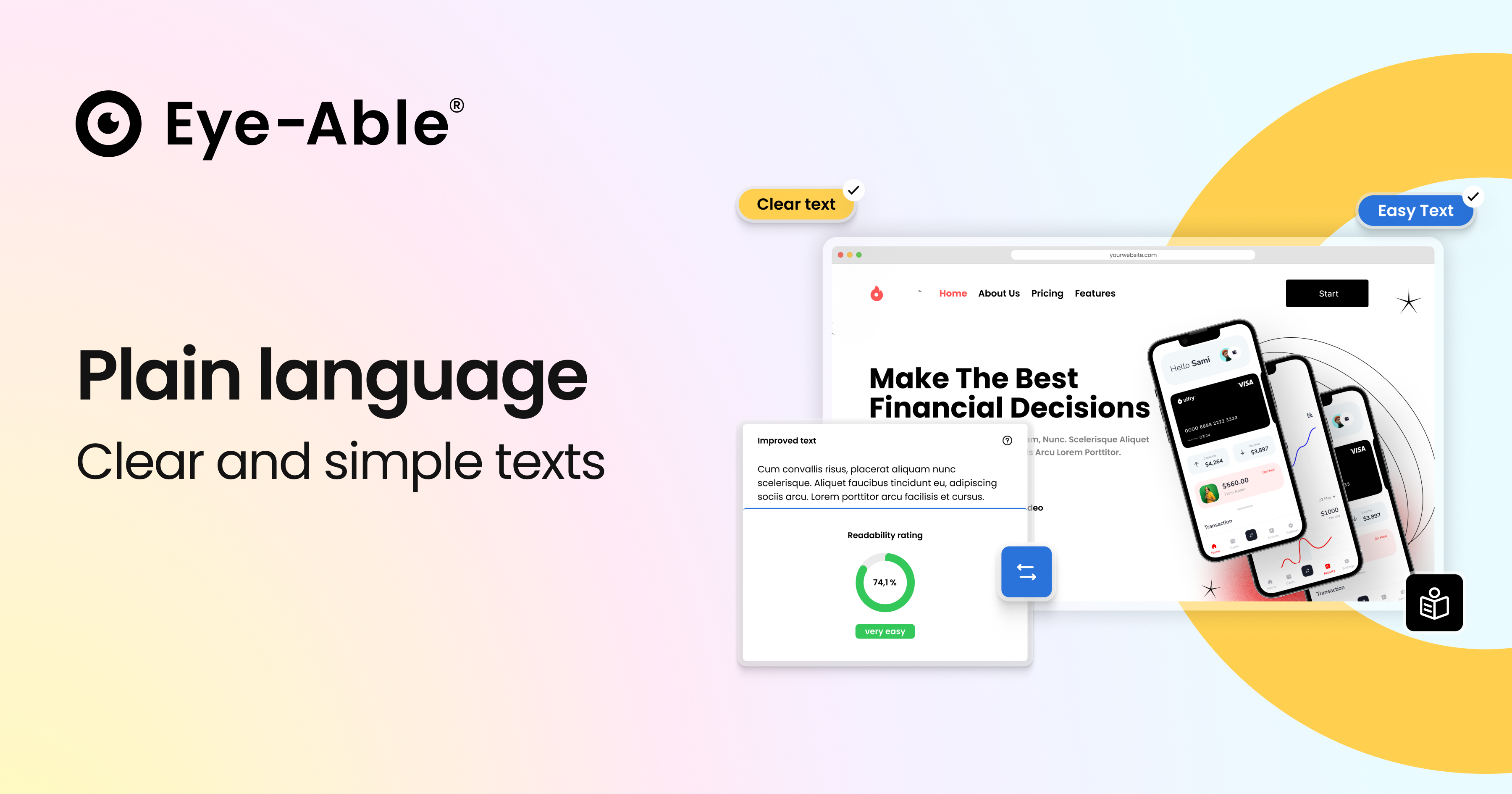 By providing content in plain language, you increase your reach and ensure clarity for everyone. You make your website more inclusive and strengthen trust among users with learning difficulties, low literacy levels, or dementia. In doing so, you aren't just fulfilling a duty; you are positioning your brand as open and accessible to new audiences.
Why this is so important:
26% of adults in Europe (aged 16–65) have low reading and writing skills.
Over 85 million people (20%) in Europe have a migrant background and benefit from clear, concise language.
To support you in this mission while meeting legal requirements, we have prepared the following text for your accessibility statement. You can easily integrate this section into your existing declaration:
This website uses the Eye‑Able Plain Language module from Web Inclusion GmbH to provide content in an easy-to-understand format. This module supports visitors who face challenges understanding complex texts due to cognitive impairments, reading difficulties, or limited language proficiency.
Eye‑Able Plain Language uses Artificial Intelligence (AI) to analyse content and transform it into a clearer form. Its features include:
Automatic simplification of texts directly on the website.
Clearer structure: Converting complex phrasing into simpler words and shorter sentences.
Multilingual support: Compatibility with various languages and an uncomplicated language switch.
User-centric: Integrated as a click-function, allowing visitors to activate Simple Language themselves whenever needed.
Quality assurance: Option for manual editing to ensure optimal clarity and precision.
The integration is carried out via a short JavaScript snippet. The use of this function serves to improve understandability in accordance with digital accessibility requirements, enabling equal access to your information for everyone.
Digital accessibility decides whether customers can shop at all. Check your website’s accessibility now – and reduce legal risk before it becomes a problem.
What does an inaccessible website really cost?
Read story:no_upscale())
Your WordPress site is never really finished: Why continuous maintenance matters
Read story:no_upscale())
A New Leadership Team for Eye-Able: Oliver Berchtold Appointed CEO
Read story:no_upscale():format(png))
HubSpot drops orange: how accessibility reshaped the CRM's design
Read story:no_upscale())
AC Monza chooses Eye-Able for digital accessibility
Read story:no_upscale())
How to make your website EAA-compliant in 8 steps
Read story:no_upscale())
Looking back at the 2026 World Cup: How accessible was the tournament really?
Read story:no_upscale())
Accessibility warnings in Austria? What European businesses need to know
Read story:no_upscale())
New: Eye-Able brings digital accessibility directly into the development environment
Read story:no_upscale())
Groundbreaking new AI-powered tests come to Eye-Able Audit
Read story:no_upscale())
One year of the EAA: Where businesses still fall short
Read story:no_upscale())
No, an overlay tool doesn’t magically make a website accessible
Read story:no_upscale():format(png))
:no_upscale():format(png))